

BTS Comeback in Seoul: Traveler Tips + Where to Eat Korean BBQ in Myeongdong
Seoul is about to get very crowded.
If you are visiting for the BTS comeback this week, do not treat it like a normal concert outing. This is not just another show at an arena where people come in, watch, and leave. BTS is returning with a free major performance at Gwanghwamun Square on Saturday, March 21, 2026, their first big group performance in nearly four years, tied to the release of their new album ARIRANG. The event will also be livestreamed globally on Netflix, and Seoul authorities are preparing for a crowd that goes far beyond the official on-site audience. Reports say around 20,000 people are expected inside the square, with roughly 240,000 more in surrounding areas, which means the wider city center will feel the impact even if you never get close to the main viewing zone.
That scale changes everything. It affects where you stay, when you move, which subway exits you use, how early you eat, and whether you make it back to your hotel without getting stuck in a sea of people. Seoul is good at handling large public events, but even a very organized city has limits when hundreds of thousands of people converge on one historic district at the same time. City officials have already announced special traffic enforcement and broader crowd-control measures around the Gwanghwamun and Sejong-daero area, with restrictions in place on March 21.
So this guide is not about fangirling. It is about helping travelers move smart, avoid rookie mistakes, and still enjoy Seoul properly during one of the biggest pop culture events the city has seen in years.
Why this comeback is such a big deal
The scale of attention around this event is not random hype. BTS has been on group hiatus while members completed mandatory military service, and this Seoul comeback concert is being framed as a major cultural return. Multiple major outlets describe it as the group’s first full-scale performance together since 2022, with the March 21 concert serving as the launch point for their next era. Their new album, ARIRANG, is reported to draw on Korean traditional roots, which is part of why the choice of Gwanghwamun Square matters so much. It is not a neutral venue. It is one of Seoul’s most symbolic public spaces, closely tied to Korean royal history, national identity, and public life.
That setting gives the event a bigger meaning than just “idol comeback.” Gwanghwamun sits near Gyeongbokgung Palace, and the square itself is one of the most recognizable civic spaces in the country. Holding the concert there sends a message: BTS is not just returning as a global pop act, but as a Korean act deliberately reconnecting with heritage and national symbolism. Whether you are a fan or not, that is part of why this event has become city-wide news rather than just entertainment news.
It also explains why security is tighter than usual. Reuters reported that President Lee Jae Myung called for strong safety and anti-terror readiness ahead of the concert, and further reporting said Seoul raised the terror alert level in parts of the city before the event. Authorities are reportedly deploying thousands of police officers and city personnel, adding entry gates, checks, and broader controls around the venue. That level of preparation reflects both the event’s global visibility and lingering sensitivity in Seoul around crowd safety after the 2022 Itaewon tragedy.
That last part matters for travelers. The city is not being dramatic. It is being cautious for a reason.
What travelers should expect on March 21
Expect central Seoul to feel busy from well before the concert starts.
Even if the actual performance is at night, movement around Gwanghwamun, Sejong-daero, Jongno, and nearby central districts is likely to get messy much earlier. Seoul has already announced special enforcement on parking and stopping violations from 9 AM to 10 PM on March 21 around the event area. That is a clear sign that this is being managed as an all-day large-scale city event, not just a nighttime show.
If you are staying in Myeongdong, you are close enough to benefit from the action but also close enough to get caught in the spillover. That is the tradeoff. Myeongdong is one of the easiest bases for tourists because it has dense hotel options, shopping, airport bus access, and convenient subway connections. But it is also in central Seoul, and when a huge event hits Gwanghwamun or Jongno, movement across the broader downtown core gets slower.
A lot of travelers make the mistake of assuming they can just “head over later.” Bad plan. For an event of this size, later usually means worse. More congestion, longer lines, heavier security, and fewer calm places to sit down and regroup. If you intend to go anywhere near the event zone, move earlier than your instincts tell you.
Useful BTS comeback travel tips that actually matter
1) Do not rely on taxis near the venue
This is one of the easiest ways to waste time and money. Around major Seoul events, the idea that you can simply call a taxi after the show is usually fantasy. With this comeback, it will be even less realistic. Road controls, congestion, and sheer pedestrian volume will make pickup difficult near Gwanghwamun. Traffic restrictions have already been announced around the core area, which means even available cars may not reach you efficiently.
Your best move is to walk away from the densest area first, then decide whether to use the subway, bus, or taxi from farther out.
2) Wear shoes for standing and walking, not for photos
This sounds obvious, but people still get this wrong. Large public-square events mean standing, slow-moving foot traffic, and possible detours. You may end up walking much farther than expected just to enter, reposition, or leave. Fashion shoes are not worth it if they destroy your feet by 8 PM. Seoul is a walking city on normal days. On an event day like this, it becomes more so.
3) Charge everything before you leave
Seoul Metropolitan Government has already warned that heavy mobile network usage in the Gwanghwamun area could disrupt real-time traffic and transit information on the day of the concert. In plain English: your phone may not work as smoothly as you expect when you need maps, messaging, or ride apps the most.
So do the basic things properly:
fully charge your phone
carry a power bank
screenshot your hotel address
screenshot the nearest subway station exits
save your key meeting point in Korean
Do not trust live data alone.
4) Pick a meeting point far from the main crowd
If you are traveling with friends, do not say, “Let’s meet by the entrance.” That is beginner behavior. In a huge crowd, “the entrance” becomes meaningless very quickly. Choose a specific backup point farther away, ideally somewhere obvious and less chaotic.
5) Eat before you get desperate
This one matters more than people think. When huge crowds gather, food lines get worse, convenience stores get picked over, and decision-making gets sloppy. Fans who have been standing around for hours often end up eating badly, too late, or not enough. Then they leave exhausted, cranky, and hungry.
A much smarter plan is to eat a real meal either before heading toward the event zone or after leaving the worst of the crowd behind.
How to get around Seoul during the BTS comeback weekend
Seoul’s subway is still your best friend. The official tourism guide says the subway generally runs from around 5:30 AM until midnight, and it remains the most reliable way to navigate the city center efficiently.
But here is the catch: “reliable” does not mean “pleasant” during a mega-event. Trains can still be packed, station platforms can feel overwhelming, and exits near the venue may move very slowly.
That is why strategy matters.
If you are staying in Myeongdong, your advantage is location. You are already in central Seoul, which means you do not need to cross the whole city to get to the general area. But because of that same proximity, you should also be realistic about congestion between Myeongdong, Euljiro, Jongno, and Gwanghwamun.
If the subway feels unmanageable late at night, night buses may help depending on where you need to go. Third-party transit summaries show several night buses passing or connecting through central districts including the Myeongdong and Jongno area, though route details can change and should be checked again on the day.
For multi-day stays, Seoul’s Climate Card can also be worth looking into. The city describes it as a transport card that allows unlimited use of public transit in Seoul for a 30-day period after recharge. For short stays, this may or may not be the best fit depending on your itinerary, but it is useful to know the option exists.
Why Myeongdong makes sense for travelers
There is a reason so many visitors choose Myeongdong, and it is not just because it is famous.
Myeongdong works because it is practical. You have hotels across different budgets, late shopping, convenience stores everywhere, tourist services, multilingual support, and quick access to other core neighborhoods. For travelers in Seoul for a major event, that matters more than staying somewhere trendy but inconvenient.
It is also a good post-event neighborhood because it gives you options. After a crowded concert or public event, most people want one of two things: to go straight back and rest, or to decompress with food before ending the night. Myeongdong is good for both.
And this is where Korean BBQ fits naturally.
Not as a forced sales pitch. Just realistically. After a long event, a proper sit-down meal is often better than random street food or another pastry grabbed on the move. Korean BBQ especially works well if you are traveling with friends because it slows the pace down. You sit, regroup, talk through the night, and eat something substantial instead of making tired decisions while wandering around hungry.
What to eat after the BTS comeback event
After an event like this, you do not need “the trendiest dish in Seoul.” You need food that is satisfying, shareable, and worth sitting down for.
That is why Korean BBQ remains one of the strongest post-event meals for travelers in central Seoul. Grilled meat, lettuce wraps, rice, banchan, and hot side dishes are filling in a way that helps after a long day of moving around. It is also easier for groups because everyone can share rather than splitting off in search of different food cravings.
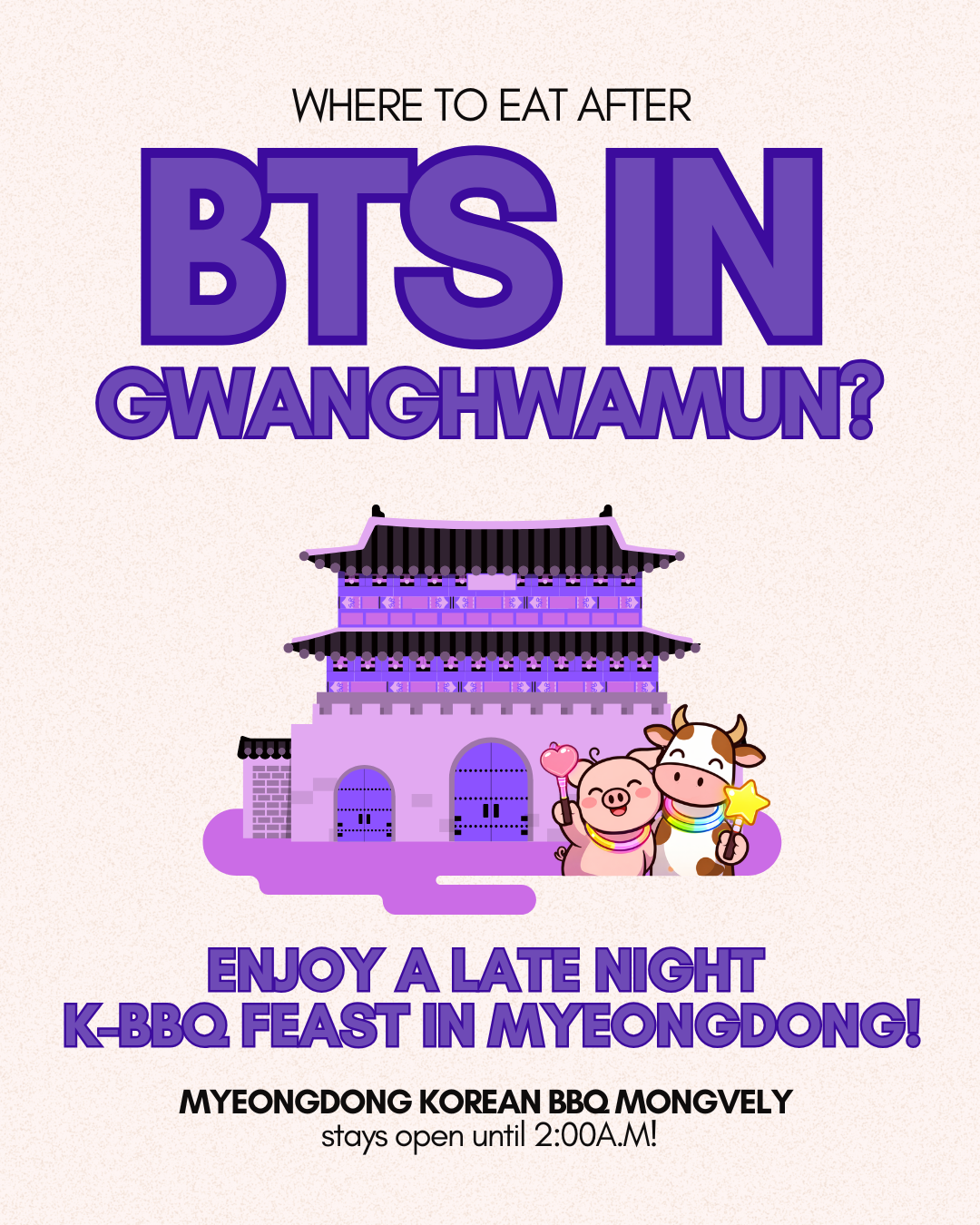
If you are in Myeongdong, this is where Mongvely makes sense as an option. Not because every sentence needs to revolve around the restaurant, but because location matters on a day like this. Being close to Myeongdong Station means you do not have to overcomplicate your evening once you are done. For travelers who want a proper Korean BBQ meal without turning dinner into another long city mission, staying in a neighborhood like Myeongdong and eating nearby is the practical move.
The key is timing. On a huge event day, the worst thing you can do is wait until you are starving and then start searching. Have a plan.
Smart food strategy for the day
Here is the version that actually works:
Eat a normal meal earlier in the day. Do not under-eat because you are “saving room” for later. That usually backfires.
Bring water. Big crowds plus standing around equals dehydration, and dehydration makes everything feel worse.
After the event, move away from the densest crowd first. Then eat.
If your group wants Korean BBQ after, choose somewhere convenient rather than chasing a random viral place that adds another 40 minutes of travel. On a normal day, food detours can be fun. On a day like this, they are usually stupid.
A simple Myeongdong plan for travelers
If you are based in Myeongdong, a practical itinerary looks like this:
Start the day in the area rather than rushing around Seoul too much. Grab coffee, shop a little, and keep the morning light. Myeongdong is packed with beauty stores, street-level retail, and easy casual stops, so you do not need to overplan the first half of the day.
Head toward the concert area earlier than you think necessary. Expect checks, slower walking speed, and bottlenecks.
After the event, do not fight the crowd blindly. Move out in stages.
Then either return to Myeongdong for dinner or, if the area is still too packed, take time to let traffic thin before sitting down to eat.
That rhythm is much better than trying to do ten different tourist activities on the same day. Seoul rewards energy, but not recklessness.
What first-time Seoul travelers often get wrong
They underestimate how big the city feels once crowds hit.
On maps, central Seoul can look close together. In reality, a short distance becomes much more annoying when you add barriers, security, traffic control, and thousands of people all moving in the same direction. That is why planning based only on map distance is a mistake.
They also overestimate spontaneity. During a normal trip, being flexible is fine. During a major public event, flexibility without structure turns into wasted time. Have your basics decided in advance: where you are going, how you are getting back, where you might eat, and what your backup plan is.
Another common mistake is trying to do everything. BTS comeback event, palace sightseeing, full café crawl, luxury shopping, street food tour, nightlife, and night photography all in one day? That sounds good on paper. In real life, it just makes you tired and sloppy.
Pick your priorities. The comeback event is the main event. Treat it that way.
Where Korean BBQ fits into the trip without forcing it
A lot of branded travel content gets this wrong. It tries too hard.
The honest version is simpler: if you are in Seoul for the BTS comeback and staying in Myeongdong, chances are you are going to need at least one solid dinner plan nearby. Korean BBQ is one of the most natural choices because it is social, distinctly Korean, filling, and easy to enjoy after a long day. That is why it belongs in the conversation.
For travelers looking for Korean BBQ in the neighborhood, Mongvely is one practical option in Myeongdong, especially for visitors who want a convenient sit-down meal rather than another rushed snack. That is all it needs to be. Not the center of the story. Just a useful answer to a real question travelers will have after the event: “Where should we eat without making the night harder than it already is?”
That approach is more credible anyway.
Final advice for BTS fans visiting Seoul this week
Do not wing it.
This comeback is too large, too public, and too logistically heavy for careless planning. BTS returning at Gwanghwamun Square on March 21, 2026, with a free performance tied to the release of ARIRANG, is not just another stop on a tour calendar. It is a city-scale event with heavy security, expected crowds in the hundreds of thousands across the broader area, and special traffic controls already announced by Seoul.
The good news is that Seoul is still one of the best cities in the world for handling visitors. Public transportation is strong, central neighborhoods like Myeongdong are practical bases, and once you understand the scale of the weekend, it becomes much easier to move smart.
So keep it simple:
plan ahead,
charge your phone,
wear proper shoes,
eat real food,
leave more time than you think you need,
and do not assume the crowd will magically sort itself out around you.
It won’t.
But if you get the basics right, this can still be one of those rare travel weekends that actually lives up to the hype.
And after all the noise, lights, waiting, and adrenaline, ending the night with Korean BBQ in Myeongdong is not a bad way to do Seoul at all.
Visit Us Now!
Mongvely Main Branch
Address: Myeongdong 8na-gil 9 3rd Floor
Opening Hours: 11:30 a.m. to 2:00 a.m.
Mongvely 2nd Branch
Address: Myeongdong 3-gil 44 2nd Floor
Opening Hours: 11:30 a.m. to 2:00 a.m.
Plan your visit → Book a Table
Follow us on Instagram → @kbbqmongvely
